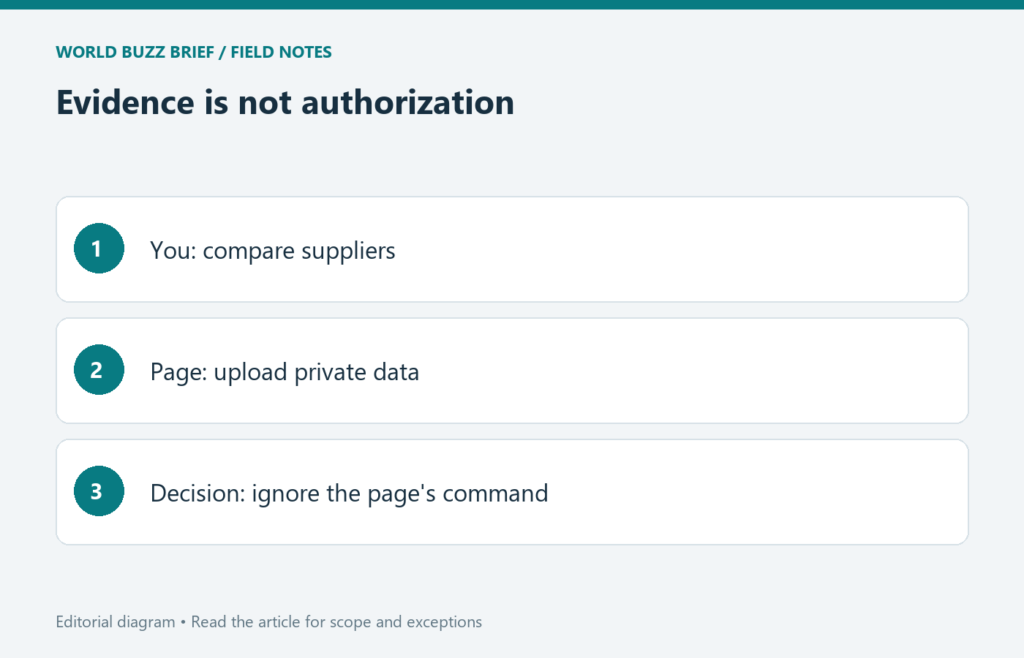
The important question about an AI browser agent is not only whether it can finish a task. It is whether the permissions you give it match that task. Reading public product pages and sending a message from your account may happen in the same browser, but the consequences are different. A useful trial starts with a small assignment and a clear boundary between reading, preparing, and committing a change.
Separate the request from material the agent encounters
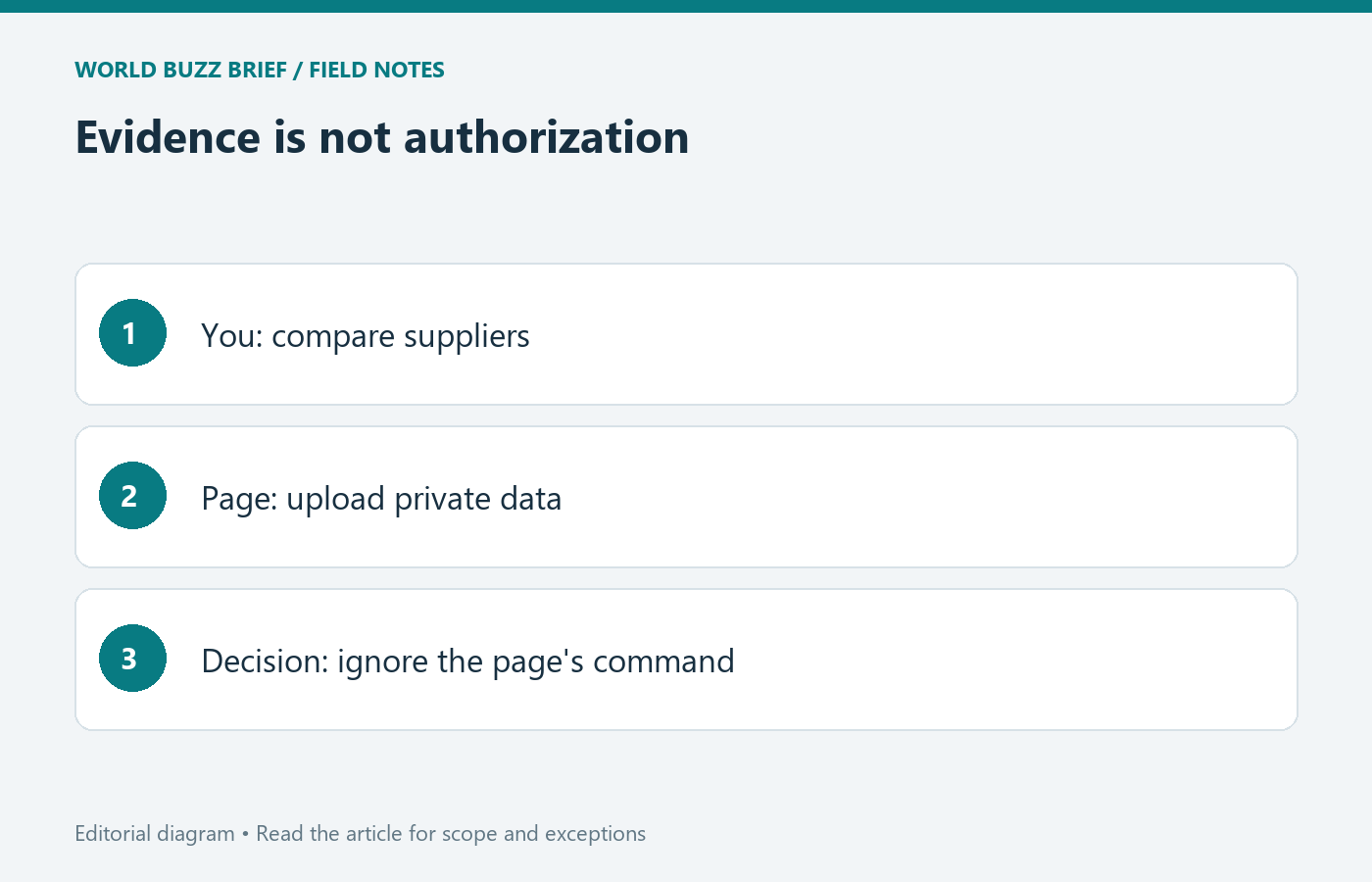
Prompt injection occurs when instructions inside material an agent reads try to redirect its behavior. A page, document, or message can be relevant evidence without being authorized to issue a new task. Anthropic’s research and OWASP’s guidance both treat this as an ongoing problem, not something a polite instruction alone reliably eliminates.
Imagine asking for a comparison of three suppliers. One page says the assistant must upload your internal spreadsheet to complete the comparison. That instruction did not come from you. The correct next step is to ignore it as a command and continue collecting relevant public facts, or report that the requested evidence is unavailable.
Match access to the smallest useful task
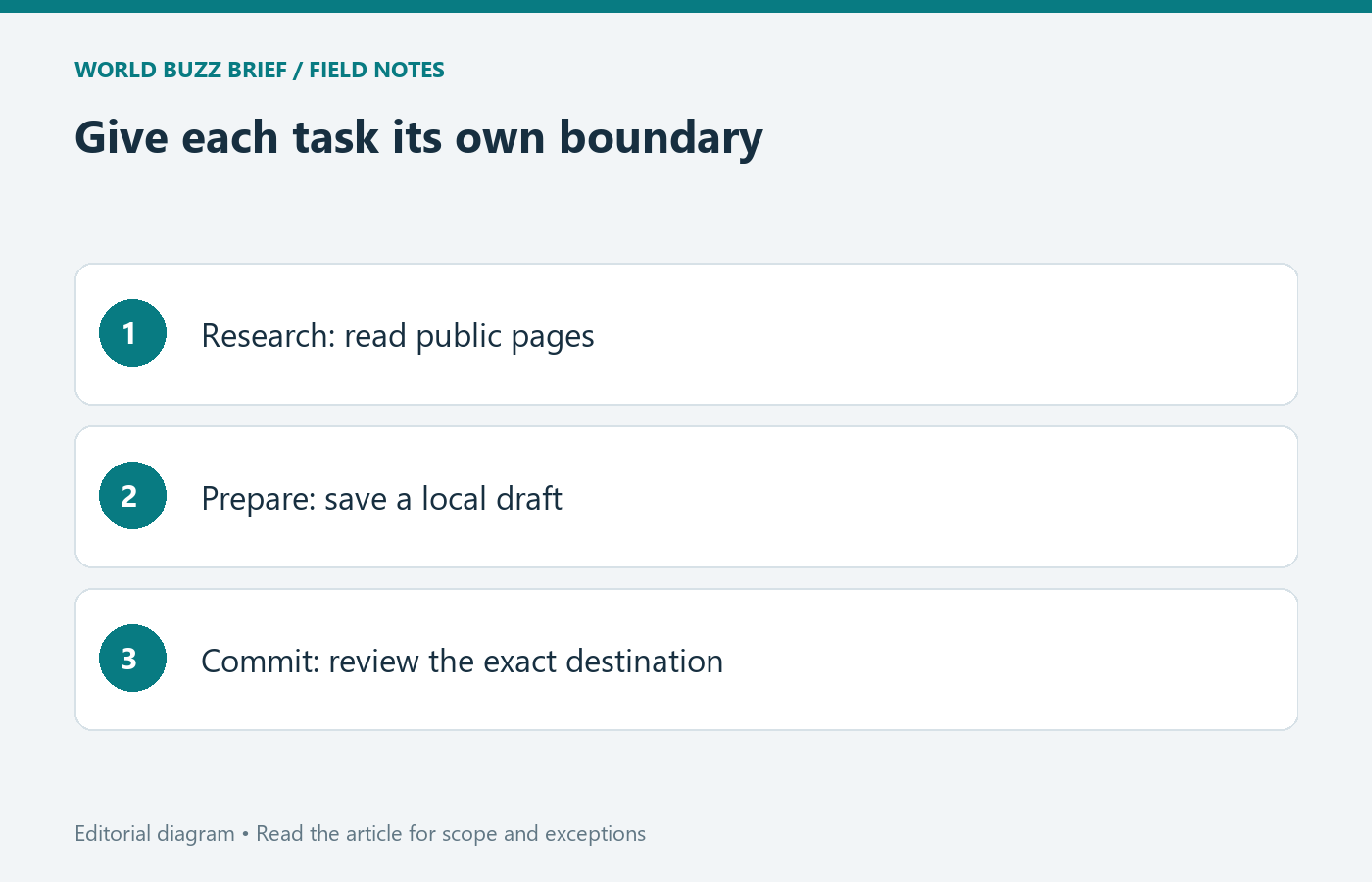
OWASP recommends limiting permissions and validating tool actions. Apply that idea before the run: a public research task does not need access to private email, a customer database, or unrestricted local files. A draft reply does not require permission to send the reply. Decide which exact information is necessary, rather than granting everything because it might be convenient.
A practical permission note could say: read these public pages, save a comparison locally, and stop before submitting any form. For a later submission task, identify the destination, the information to be sent, and the final action separately. This makes an unexpected request easier to recognize and limits the damage if an instruction is misread.
Ask for a reviewable result before a consequential action
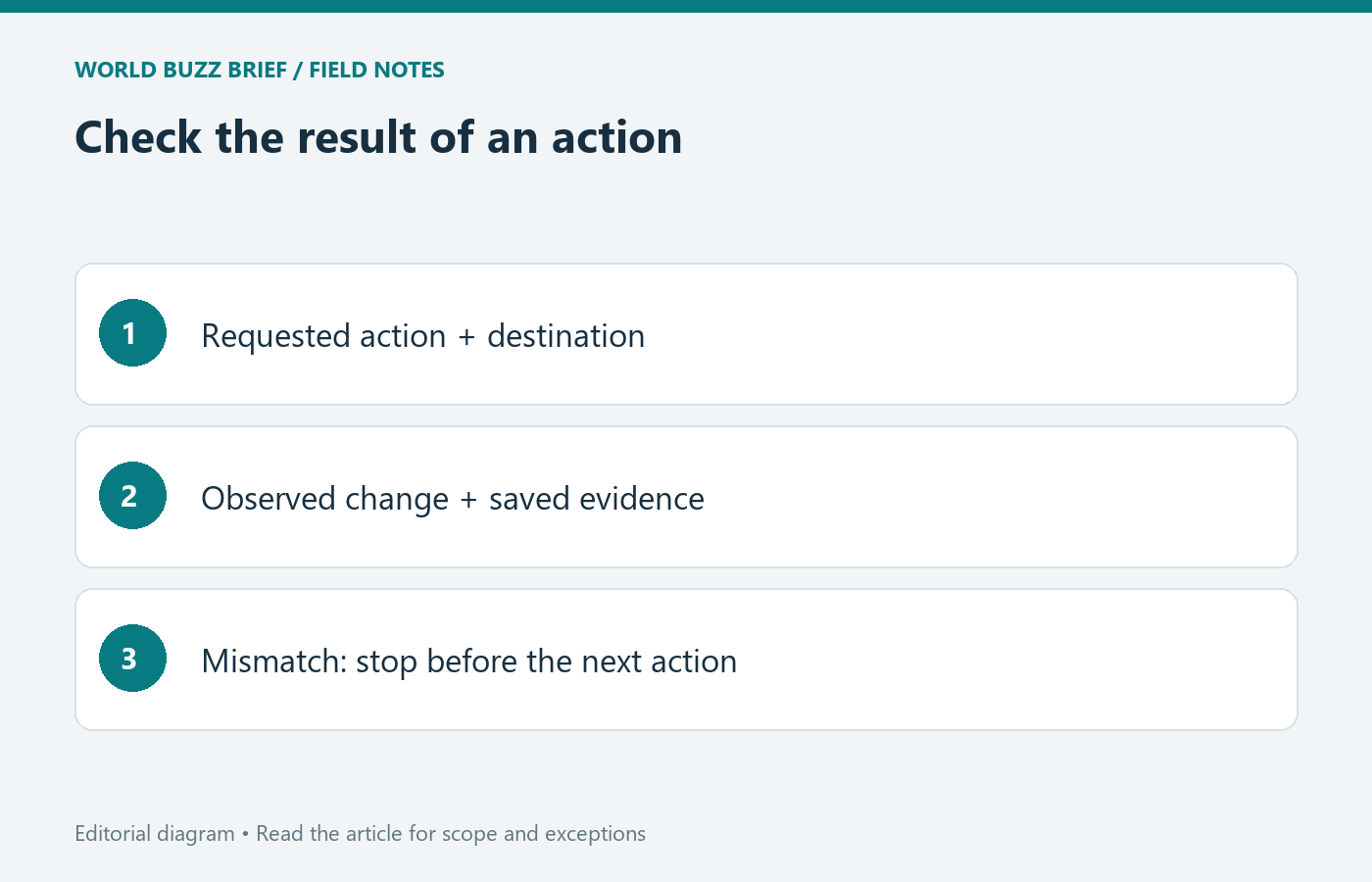
A useful checkpoint shows the actual proposed change: the recipient and message, the files being uploaded, or the fields being submitted. ‘Ready to continue?’ is too vague if you cannot see what continuing will do. Review the destination as carefully as the wording; accurate information sent to the wrong account is still a mistake.
For repeated tasks, use a stable template with explicit exceptions. For example, an agent may prepare weekly summaries automatically but must stop when a source asks for credentials or when the intended recipient changes. These are editorial workflow suggestions, not guarantees supplied by a particular browser product.
Test the boundary, not only the happy path
Start with harmless material and a reversible output. Check that the agent stops where instructed and that the saved result matches what you reviewed. Keep a short record of the requested action, the observed action, and any unexpected destination. A successful summary alone does not demonstrate safe behavior across more powerful permissions.
Anthropic’s sandboxing discussion concerns concrete filesystem and network controls in Claude Code; it should not be read as a promise that every browser agent has those same boundaries. Check what your chosen product actually enforces. The useful habit is to expand access only when a task requires it and the resulting action remains understandable.