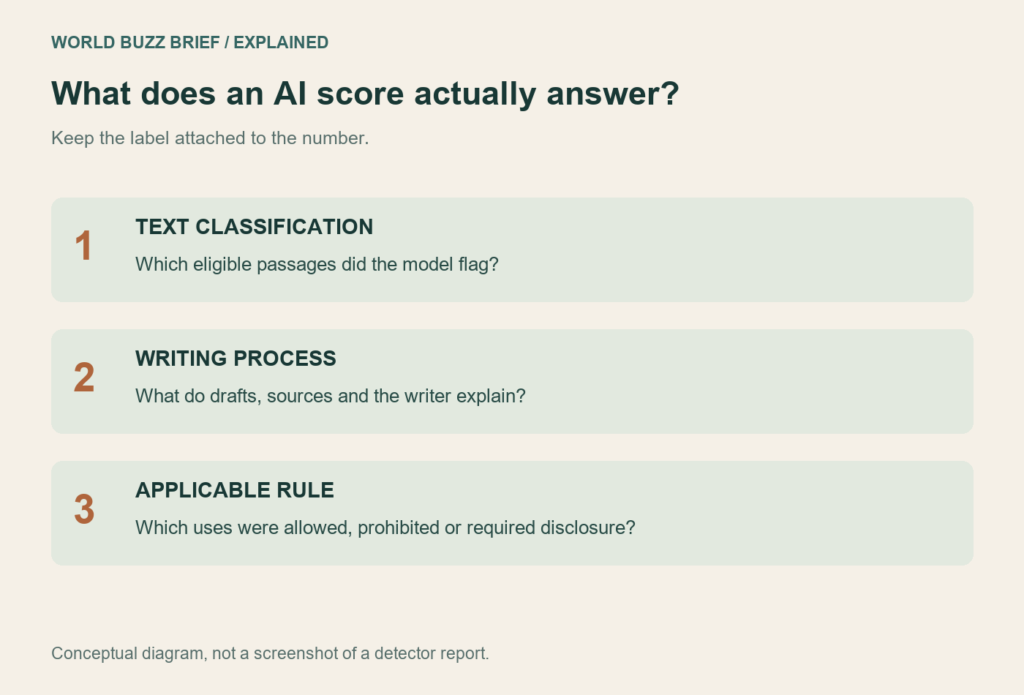
A report says “40% AI.” Before treating that as a verdict, ask what the percentage measures. Is it a share of text, a confidence estimate, or something else? Those meanings lead to different conclusions—and none, by itself, explains how a person wrote the document.
The useful response to a suspicious report is to preserve the work, inspect the flagged passages and ask for the process behind them. Chasing a lower detector score can destroy the very draft history that would make the writing easier to evaluate.
Read the definition before interpreting the number
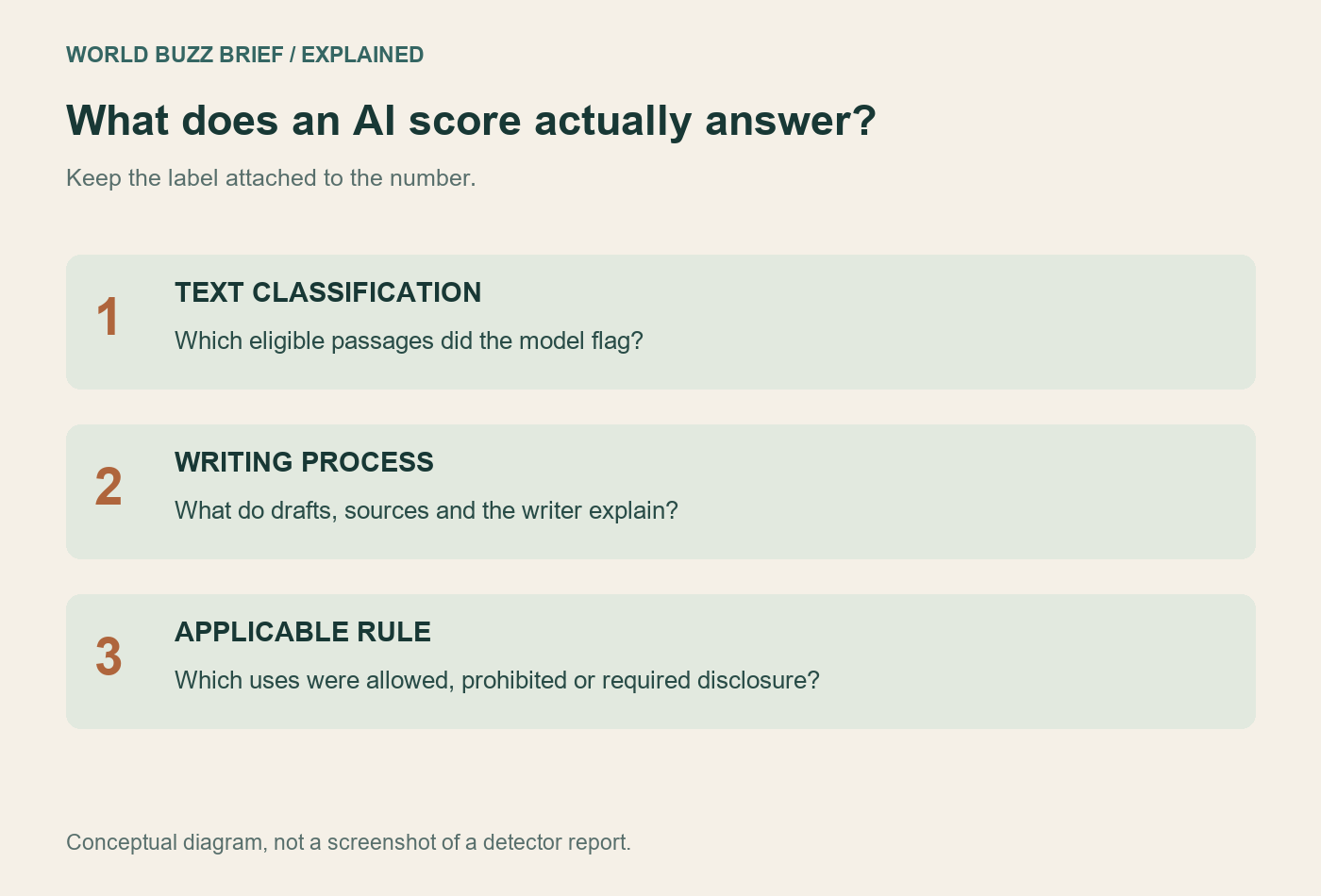
In Turnitin’s report, the overall percentage concerns qualifying long-form prose that its model identifies as potentially AI-generated or subsequently altered. It is not a 40% probability that a writer cheated. The AI indicator is also separate from the similarity score.
The same guide says results above zero but below 20% appear as an asterisk rather than a numerical score in newer reports, because that range has a higher incidence of false positives. An asterisk is not proof of either human authorship or misconduct. Turnitin explicitly advises against using the report alone for adverse action.
Other products may define their numbers differently. Keep the report’s product name, date, version if shown and explanation together. A screenshot of a percentage with its label cropped off is weak evidence for a strong accusation.
A small false-positive rate can still matter
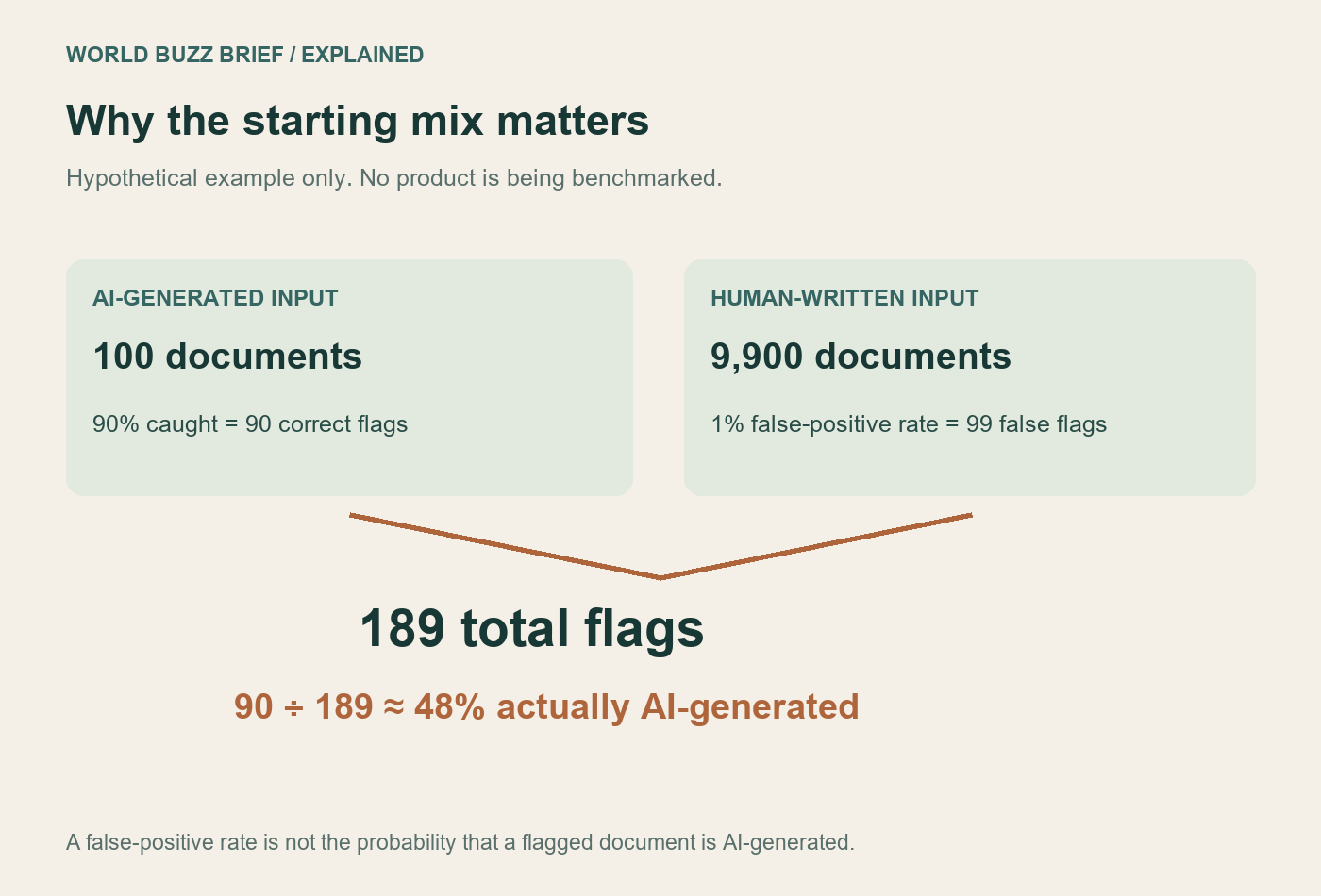
Imagine 10,000 documents: 100 are AI-generated and 9,900 are human-written. Suppose a hypothetical detector catches 90% of the first group and incorrectly flags 1% of the second. It produces 90 correct flags and 99 false ones. Among the 189 flagged documents, about 48% are actually from the AI-generated group.
Nothing in that calculation means a real detector has those rates. It shows why a low false-positive rate is not the same statistic as the probability that a flagged document is AI-generated. If the starting mix changes, the interpretation changes too.
Vanderbilt’s August 2023 decision to disable Turnitin’s AI detector raised the practical consequences of errors at institutional scale. That is a dated institutional decision, not a new announcement or evidence that every institution follows the same policy.
Old tests reveal failure modes, not today’s universal accuracy
A 2023 study by Liang and colleagues found that the detectors it examined disproportionately misclassified non-native English writing. That finding matters when predictable phrasing is treated as suspicious. It does not establish that every current product, language or version has the same error rate.
A separate 2023 comparison by Weber-Wulff and colleagues also reported reliability problems in the tools tested. Meanwhile, vendors continue changing their models: Turnitin maintains a dated product-update record. A useful accuracy claim must name the tested version, document types, languages and evaluation conditions.
This cuts both ways. An old failure cannot prove that a current detector is useless, and a current vendor claim cannot establish that this particular flag is correct. Ask what evidence connects the test conditions to the document being judged.
Review the writing process without turning it into a guessing game
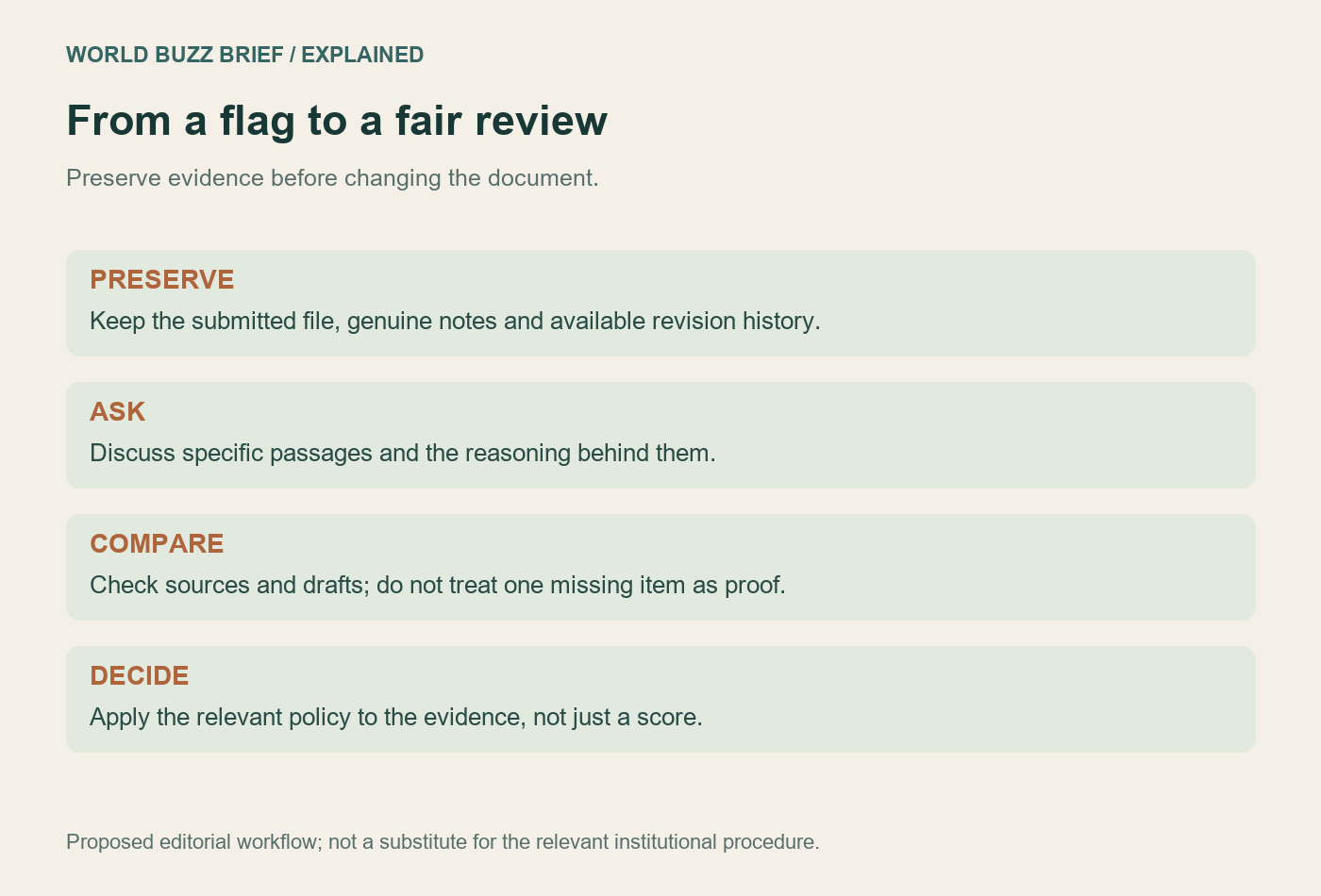
For a writer, the first step is to keep the submitted file unchanged. Retain any genuine outlines, source notes, revision history and records of permitted tool use. Do not manufacture a draft trail after the fact. When asked about a passage, explain the argument, why a source was selected and what changed between drafts.
For a reviewer, start with a specific passage and a neutral question: “How did you get from this source to this conclusion?” Compare the response with the text and available work history. A missing early draft is not, on its own, proof of misconduct; different writing methods leave different traces.
Finally, separate what happened from what was allowed. Spellchecking, transcription, translation and generated prose are different activities, but the applicable assignment or publication policy decides which uses require disclosure or are prohibited. Record the evidence, the explanation and the policy separately before reaching a conclusion.
A stronger review ends with an explainable judgment about the actual work. “The meter was high” is a starting observation, not that explanation.